Essay · June 2026
AI FOMO: When Leaders Are Forced to Adopt Without Readiness
Executives feel pressure to deploy AI even as the majority say their organizations are unprepared. That tension is reshaping boardroom conversations — and making many leaders anxious about the future.
Across industries, the boardroom conversation has shifted from should we explore artificial intelligence to why aren't we moving faster? Shareholders demand action. Customers expect new digital experiences. Competitive peers boast of "AI-powered" products. The result is a palpable sense of urgency. A global survey by ABBYY found that 63 percent of IT leaders worry their company will be left behind if they don't invest in AI, and 55 percent say customer pressure is a key driver for adoption. In Australia, 73 percent of IT leaders fear their firm will fall behind without AI. This fear of missing out ("AI FOMO") is increasingly dictating strategy.
Yet behind the bravado, most executives admit they aren't ready. McKinsey's State of Organizations 2026 report shows that 86 percent of leaders feel their companies are not prepared to adopt AI in day-to-day operations and one in six organizations have no clear C-level owner for AI adoption. Even among firms that are deploying generative AI, only 1 percent of U.S. executives describe their rollout as mature and just 19 percent report a revenue increase greater than five percent. A Deloitte study reaches a similar conclusion: 42 percent of companies believe their AI strategy is "highly prepared," yet they feel much less ready when it comes to infrastructure, data quality, risk and talent. Those gaps are not trivial — 53 percent of organizations say insufficient worker skills are the biggest barrier to integration.
Confidence without capability is a dangerous combination.
A survey of 57 percent of organizations reported strong executive confidence in their AI strategies, but only 28.5 percent were even moderately prepared to deploy AI from a data perspective and just 8.6 percent were fully AI-ready. The underlying problems are structural: fragmented systems, inconsistent data hygiene and weak governance. In this environment, the promise of AI becomes a liability. TechClass notes that up to 70 percent of companies see minimal impact from AI and 87 percent of projects never reach production, often because initiatives begin as hype-driven experiments without a clear business case. Gartner predicts that more than 40 percent of ambitious "agentic" AI projects will be cancelled by 2027 due to escalating costs and unclear value. When executives chase headlines instead of outcomes, they end up with pilots that burn cash and produce little return.
Why leaders keep pressing forward
Fear is a powerful motivator. In Freshworks' 2024 Global AI Workplace Report, more than a third (37 percent) of respondents said their organization is suffering from AI FOMO, while 46 percent believe any company not using AI is already behind. The ABBYY study found that more than half of global business leaders feel customer pressure to adopt AI. In the same research, misuse by staff (35 percent), costs (33 percent) and hallucinations or lack of expertise (32 percent) ranked as bigger concerns than regulatory and compliance risk. A separate survey focusing on Australian IT leaders echoes the theme: 97 percent plan to increase AI investment despite 39 percent worrying about implementation costs and 37 percent citing lack of talent.
These numbers reveal the psychological undercurrent driving AI adoption. Leaders are not just chasing efficiencies; they are reacting to a fear of falling behind, of losing relevance, of appearing timid to investors. Research from the OECD highlighted by Technology in Society shows that more than one in nine adults report elevated anxiety about not keeping up with AI. And ABBYY's own survey found that 60–70 percent of technology leaders cite FOMO as a major reason their organization is investing in AI. The anxiety doesn't just live in executive suites; employees worry that AI will reduce their autonomy or devalue their skills. There is a feedback loop at play: investment without strategy breeds mixed results, which heightens anxiety and encourages yet more hasty investments.
A technology cycle moving faster than leaders can digest
If this feels unsettling, it should. We are watching a technology cycle accelerate faster than leaders can digest. Historically, executives have been rewarded for decisive bets on new technologies. But AI touches every function of an enterprise, from product to compliance to culture. It cannot be delegated entirely to vendors, yet few leadership teams have the depth of experience to govern it effectively. The National Credit Union Administration warned that credit unions exploring AI face unique risks around algorithmic decision-making, fair lending, data privacy and operational resilience — issues that apply just as readily to banks, healthcare providers and manufacturers. Without careful due diligence and robust risk management, AI deployments can introduce governance and compliance issues faster than they deliver benefits.
Slow down and build readiness intentionally
What should executives do when they feel outmatched by a technology and simultaneously pressured to adopt it? The answer is to slow down and build readiness intentionally. That means investing in data quality, modernizing infrastructure, and establishing clear governance before rolling out a flashy generative AI assistant. It means upskilling the workforce, not just the data science team, so that everyone can interpret and challenge AI outputs. It means aligning AI investments with balance-sheet outcomes — growth, cost reduction, risk management — rather than abstract "innovation" metrics. Above all, it means resisting fear as a strategy. As TechClass notes, many AI projects fail because executives succumb to competitive pressure or FOMO rather than defining specific problems and success metrics.
AI will reshape every industry, but it does not absolve leaders of judgment. The organizations that thrive will be those that approach AI as an assistive tool first, automate only after processes are understood, and ultimately use the technology to augment human decision-making — not to replace it. Fear can be a catalyst for change, but when it becomes the dominant driver of adoption, it leads to reactive decisions that compromise trust and erode value. To build AI-ready organizations, executives must confront their own anxieties, acknowledge the gaps in their preparation and choose intentional, human-centered deployment over hasty experimentation.
About the author
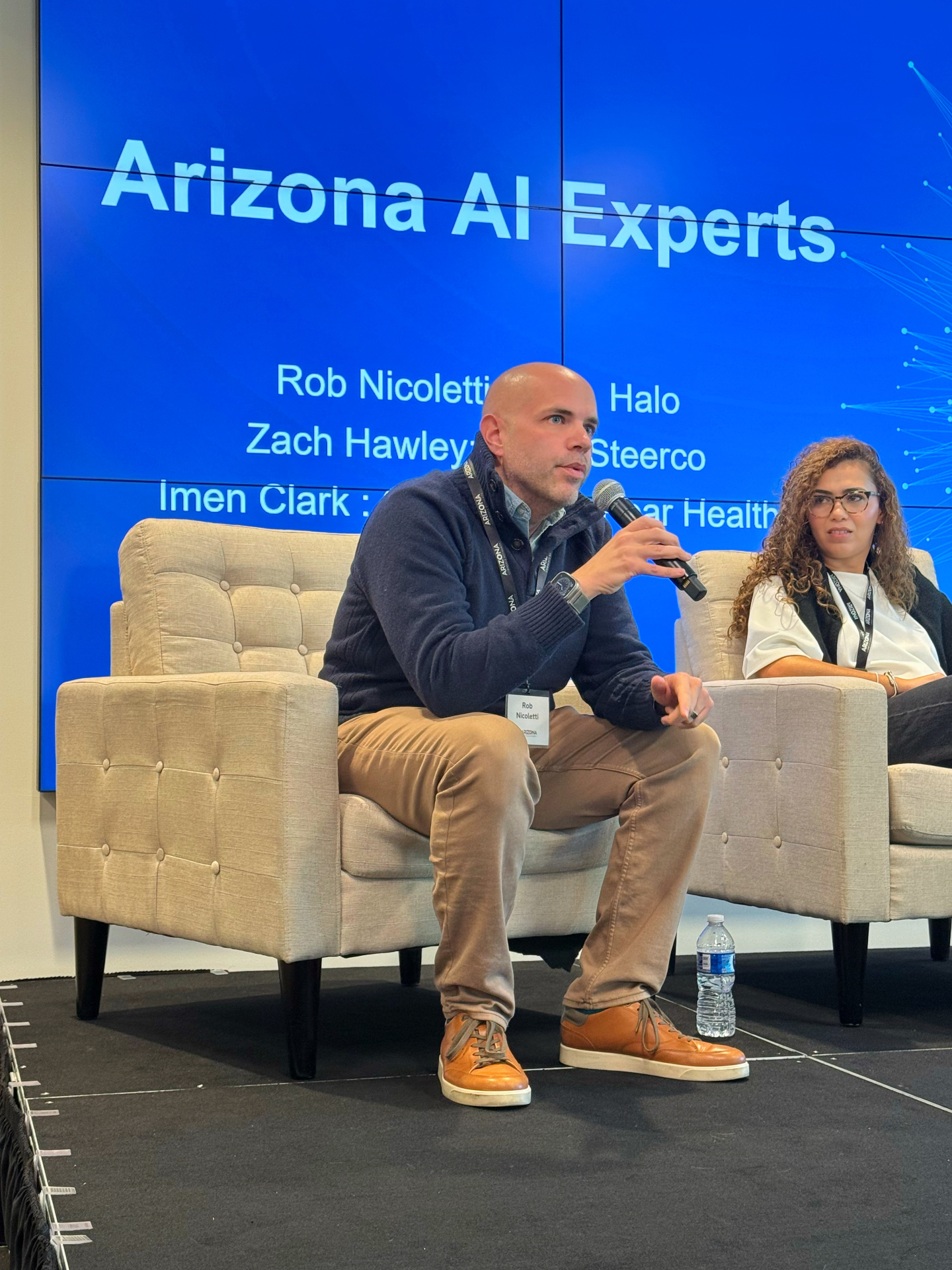
Rob Nicoletti
Founder, create human
Rob is the founder of create human and the architect behind HALO. He has spent the last two decades inside operating teams — building, scaling, and occasionally rescuing them — and writes here about AI, leadership, and what it takes to build organizations where humans become greater, not smaller.
Newsletter
Get the next essay in your inbox.
One email when the next piece of writing lands. No marketing, no list-sharing.