Essay · July 2026
Owning the Future: AI Sovereignty, Resilience and the Global Digital Economy
From tools to sovereignty — why enterprises and nations are moving from renting intelligence to owning the stack that runs their world.
A new AI narrative: from tools to sovereignty
At the dawn of generative AI, businesses and governments rushed to adopt large language models as if they were just another productivity tool. That phase is over. Today, the debate has moved from "What can AI do for me?" to "Who owns the intelligence running my world?" This shift was summed up in a striking exchange when Palantir CEO Alex Karp told CNBC that enterprise customers are tired of paying "tokens that create no value" and instead want control over their compute, models, data, and operational know-how. Karp urged buyers to ask vendors direct questions — "Are you keeping the data? Are you going to enter our business?" — and to insist on "own[ing] the means of production." The message resonated because it captures a broader truth: access to AI is no longer enough; sovereignty matters.
Access to AI is no longer enough; sovereignty matters.
Sovereignty in AI means that organisations and nations have the right to govern their data, models, compute and operational logic — while still participating in a global ecosystem. The concept is now central to boardroom and cabinet discussions. Dataiku's 2026 AI sovereignty manifesto observes that a government order recently took the world's best model offline, showing how quickly rented intelligence can be revoked. It warns against "being collateral" in a power struggle between labs and states and cautions that renting AI gives vendors the power to raise prices or shift roadmaps. Meanwhile, Boston Consulting Group's (BCG) study on national AI strategies notes that only a handful of superpowers and middle powers have the resources to pursue full-stack AI autonomy; for most countries, AI sovereignty conceived as complete self-sufficiency is an illusion. Yet the study also argues that resilience — the capacity to use, adapt and govern AI domestically while minimising strategic dependencies — is attainable.
Understanding the AI stack: models, compute and the operating layer
To appreciate why sovereignty has become so important, consider the structure of modern AI. The stack can be thought of as three layers:
- Model layer: Frontier labs such as OpenAI, Anthropic, Google and emerging state-funded efforts develop large language models. These models are powerful but increasingly commoditised and subject to geopolitical tension.
- Compute layer: Scarce chips, network systems and data-centre infrastructure — largely supplied by companies like NVIDIA — provide the computational foundation. Nations and enterprises cannot run AI without access to GPUs, and global supply chains make this layer highly interdependent.
- Application/ontology layer: This is where data, workflows and human decisions are translated into AI-enabled action. Palantir's Ontology, Dataiku's platform and HALO's Cortex+Connect+Pulse+LEO framework all operate at this layer. They organise complex data, enforce governance, capture institutional knowledge and orchestrate models to produce auditable outcomes.
Sovereignty debates focus on controlling the application and compute layers, not just models. Palantir's sovereign AI reference architecture illustrates the point. According to Constellation Research, the architecture bundles Palantir's applications (Foundry, AIP, Apollo and Rubix) with NVIDIA's GPUs, AI Enterprise software, CUDA libraries and Nemotron open models for on-premises deployments designed for low latency and data sovereignty. It provides hardened Kubernetes clusters, zero-trust networking and an autonomous deployment framework that allow customers to run models within their own facilities. By integrating open-weight models with secure compute and a robust operational layer, the architecture lets enterprises swap models without losing their logic or data. Jensen Huang, CEO of NVIDIA, described the purpose of combining Ontology with accelerated computing as enabling organisations to "tap into their data to power domain-specific automations and AI agents."
Why sovereignty matters: enterprise, national and human considerations
For enterprises
Businesses that rely on generic chatbots risk more than cost overruns. They risk losing control of their "operational alpha" (the proprietary knowledge embedded in workflows). Karp's critique captures the frustration: paying metered token fees to vendors who may learn from, replicate or commoditise the very processes that make a company competitive. Dataiku's manifesto adds a practical checklist: avoid intelligence you can be cut off from, avoid renting what runs your business and refuse to be locked into binary choices between performance and independence. Instead, companies should ensure that infrastructure (where AI runs), capability (who builds and governs it) and economics (who captures the value) remain under their control. That means deploying AI on trusted hardware, using models whose weights can be inspected or replaced and embedding them in an operational layer that preserves decision logic and audit trails.
For nations
While enterprises focus on competitive advantage, governments grapple with sovereignty at scale. BCG's report warns that only a few countries can afford full-stack autonomy; even Australia's attempt to build a national LLM required partnership with global hardware and data providers. India's IndiaAI program, with tens of thousands of GPUs, enhances domestic bargaining power but still trails private hyperscalers. The report concludes that AI resilience — ensuring domestic ability to run sensitive workloads and comply with national rules — is more pragmatic than total independence. It recommends shared high-performance computing (HPC) facilities like Europe's EuroHPC program and targeted policies that bring capacity onshore, such as India's data-localisation directive, which created an anchor for domestic processing.
The geopolitical context cannot be ignored. As Brookings notes, increasing geopolitical tension has spurred a rise in digital sovereignty, defined as a nation's ability to control its digital destiny. Fears of being cut off from critical components such as chips and a lack of control over cross-border data flows have led to market fragmentation. The European Union has responded with a holistic regime: the General Data Protection Regulation (GDPR), the Digital Markets Act, the Digital Services Act and the forthcoming AI Act establish a risk-based framework for AI systems, from banning certain high-risk applications to imposing transparency requirements. In contrast, the United States has historically favoured a light-touch approach, leaving companies more freedom while emphasising innovation. China's Personal Information Protection Law (PIPL) introduces its own data-governance model. These divergent regimes illustrate the challenge: global AI governance is fractured, and sovereignty initiatives can accelerate fragmentation if they turn inward.
For people and society
The sovereignty conversation ultimately serves people. AI that answers to someone else can undermine privacy, autonomy and human rights. Ensuring that AI is accountable to those it affects means embedding ethical oversight, fairness and transparency into the operational layer. Governments, civil society and industry must work together to ensure that sovereignty does not become a pretext for digital nationalism or surveillance but rather a framework for trust and inclusion. Without such safeguards, digital fragmentation could exacerbate inequality and hinder global cooperation on climate, health and other collective challenges.
The sovereign AI blueprint: resilience and open collaboration
What does a resilient, sovereign AI strategy look like? Across enterprises and nations, several principles emerge:
- Secure compute and data control. Invest in domestic or trusted cloud infrastructure capable of running high-value workloads. As BCG notes, the goal is not to match hyperscalers but to ensure that sensitive workloads can run locally, compliance is feasible and capacity is predictable. EuroHPC's national HPC systems and India's data-localisation directive show how public investment and targeted rules can build a baseline of capacity.
- Open or controllable models. Use models whose weights can be inspected, modified and, where necessary, fine-tuned on proprietary data. Dataiku advises using frontier models for edge cases but running core workloads on open-source models to maintain leverage and avoid dependence. Palantir's architecture integrates open models like Nemotron, allowing customers to swap models without rewriting business logic.
- A robust operational layer. Organise data and workflows into a structured knowledge graph or ontology that preserves institutional intelligence. This layer should capture roles, rights, routines, runbooks and results; enforce governance and auditability; and orchestrate models and rules. HALO's Cortex + Connect + Pulse + LEO framework, Palantir's Ontology and Dataiku's platform all serve this function. By decoupling domain knowledge from any specific model, the operational layer ensures that switching models or compute providers does not erase organisational memory.
- Ethical and interoperable governance. Adopt regulatory frameworks that protect rights and foster innovation. The EU's risk-based AI Act sets a useful precedent by banning unacceptable uses and imposing transparency on high-risk systems. At the same time, policymakers should promote interoperability and cross-border cooperation to avoid a patchwork of incompatible rules. Global initiatives — such as the United Nations' AI for Good Summit and emerging AI governance dialogues — can help align standards and avoid digital fragmentation.
- Partnerships and shared ecosystems. Recognise that no organisation or country can go it alone. Shared HPC facilities, open-source consortia and cross-border research programs help distribute costs and pool expertise. BCG points out that countries should deliberately shape how they are embedded in the global AI value chain, balancing domestic capability with international partnerships.
Implications for leaders and creators
For business leaders
- Treat AI as strategic infrastructure. Align AI investments with business-critical workflows and consider ownership, auditability and resilience as core requirements. Avoid being locked into vendor-owned models and token billing; instead, insist on model interchangeability and transparent pricing.
- Build a sovereign operating layer. Capture your company's knowledge graph and decision logic in a platform that is vendor-agnostic. Ensure that data governance, role-based access and workflow capture are first-class capabilities.
- Champion open ecosystems. Participate in open-source communities and consortia; contribute domain expertise; and leverage community models. Open models not only provide leverage against proprietary providers but also enable collective problem-solving and innovation.
For policymakers and public leaders
- Prioritise AI resilience over autarky. Recognise that full-stack sovereignty is unattainable for most nations and instead invest in domestic capacity, data governance and talent programs to ensure you can run and adapt AI domestically.
- Foster cross-border collaboration. Work with allies and industry to build shared compute, open models and interoperable regulatory frameworks. Avoid policies that fragment the global digital commons.
- Embed human rights. Ensure that AI sovereignty initiatives include commitments to privacy, non-discrimination and transparency. The goal is not to replace one form of dependency with another but to build a trustworthy digital order that respects human dignity.
Conclusion: building a shared and sovereign AI future
The AI revolution is not merely a competition for better algorithms or faster chips; it is a struggle over who controls the intelligence that will run our economies, institutions and daily lives. Enterprises want to own their operational intelligence rather than rent it; nations seek digital sovereignty to avoid being cut off from vital technologies; citizens demand AI that respects their rights. Yet, as BCG cautions, full-stack autarky is an illusion. The real path forward is a blend of sovereignty and resilience — owning critical pieces of the stack while participating in a global ecosystem built on open models, shared infrastructure and ethical governance.
The world is at a crossroads. If we pursue AI sovereignty in isolation, we risk fragmentation, inequality and innovation slowdown. If we abdicate sovereignty entirely, we risk dependence on a handful of vendors or governments. Thoughtful leaders will chart a middle course: building domestic capacity, capturing institutional knowledge, insisting on openness and interoperability, and collaborating across borders. By doing so, we can ensure that AI serves humanity not as a black box beyond our control but as a collective resource that empowers us all.
About the author
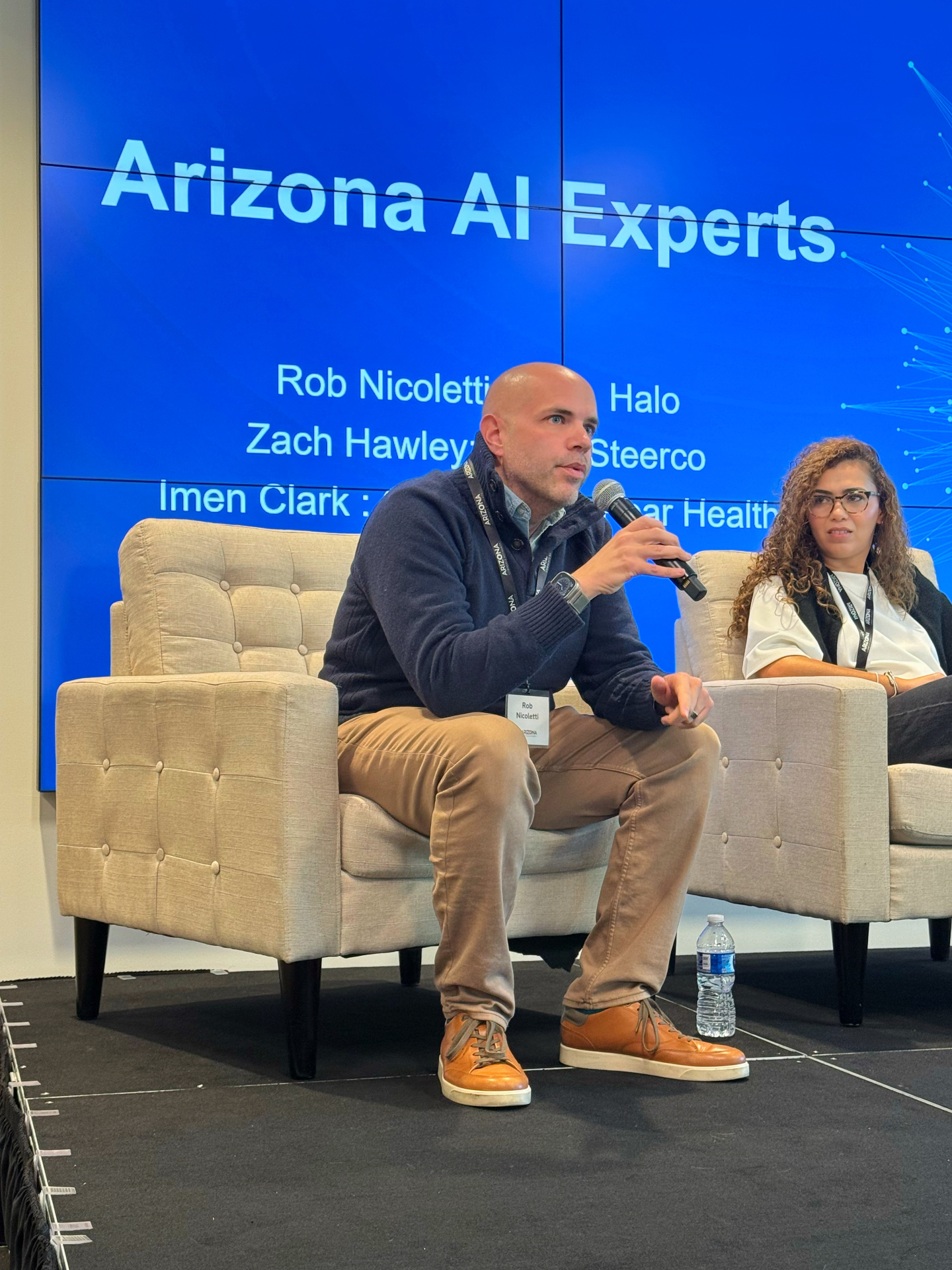
Rob Nicoletti
Founder, create human
Rob is the founder of create human and the architect behind HALO. He has spent the last two decades inside operating teams — building, scaling, and occasionally rescuing them — and writes here about AI, leadership, and what it takes to build organizations where humans become greater, not smaller.
Newsletter
Get the next essay in your inbox.
One email when the next piece of writing lands. No marketing, no list-sharing.