Essay · August 2026
AI Is a Marathon, Not a Sprint
The companies that win with AI won't be the ones that adopt the most tools. They'll be the ones that build the operating system required to use AI well.
I spend a lot of time talking with executives about AI. And I've noticed something happening over and over again.
When I show people what we're building with HALO — an environment where AI can understand the business, see data across the organization, surface insights, help executives make decisions, generate work, orchestrate workflows, and eventually automate more of what happens inside a company — they get excited.
Then comes the inevitable question: "How quickly can we have all of that?"
That's where I think we need to reset expectations about AI. Because the future people are imagining is absolutely possible. But getting there is a transformation, not an installation.
You have to crawl before you walk. You have to walk before you run. And you probably shouldn't let AI run your business before you've taught it how your business actually works.
Access to AI is not the same as being ready for AI
One of the biggest misconceptions I see right now is that having ChatGPT, Claude, Gemini, or another AI tool means a company is becoming "AI-enabled." These are extraordinary tools. In some cases, ChatGPT or Claude can do something today faster or better than HALO can. That's okay. That's not the problem we're trying to solve.
A great AI model can help an individual write something, analyze a document, research a topic, reason through a problem, or build an application incredibly quickly. But an organization is not an individual.
An organization has hundreds or thousands of decisions happening across marketing, sales, operations, HR, customer experience, finance, and leadership. It has goals, metrics, people, responsibilities, processes, systems, data, permissions, institutional knowledge — and sometimes decades of accumulated complexity.
For AI to become truly useful across that environment, it needs more than intelligence. It needs context.
The prototype isn't the hard part anymore
We're also entering the era of vibe coding. Someone inside a company can now build a dashboard, agent, workflow, application, or automation in a weekend. That's incredible, and companies should experiment. But there's a big difference between building something and operating something.
The demo might take a weekend. The system has to survive Monday morning.
Someone eventually has to think about:
- Security, permissions, and governance
- Business logic and data quality
- Integrations, orchestration, and reliability
- Model changes, monitoring, and maintenance
- Institutional knowledge — and what happens when the employee who built the thing leaves
Multiply that by 20 departments independently experimenting with AI and we could very easily recreate the exact problem businesses spent the last decade creating with SaaS. Except instead of SaaS sprawl, we'll have AI sprawl — hundreds of disconnected agents, workflows, prompts, applications, and automations that nobody fully understands.
That's not transformation. That's another layer of complexity.
AI needs an operating system
This is the realization that has increasingly shaped how I think about HALO. Most companies don't have an AI problem. They have an operating system problem.
Their objectives aren't always clear. Their metrics aren't standardized. Ownership isn't always defined. Their systems don't communicate. Their data is fragmented or unreliable. Their processes live inside people's heads. Their operating cadence is inconsistent. And then we drop artificial intelligence on top of all of it and expect magic.
AI doesn't eliminate those problems. In many cases, it magnifies them. If we want functional AI, we first need to create the environment in which AI can function.
Alignment before automation. Context before intelligence. Structure before scale.
Crawl: structure the business
I think companies need to stop thinking about AI transformation as a software implementation and start thinking about it as a maturity curve. Before AI can intelligently operate across a company, the company needs to define how it operates.
- Where are we going, and what are our priorities?
- What metrics matter, and who owns them?
- What are our critical workflows?
- What systems contain our information?
- How do we make decisions?
This work isn't particularly futuristic. But it creates the foundation for everything that comes next.
Walk: make the data usable
Then you start connecting the organization. Inventory the data. Clean it. Standardize it. Define it. Govern it. Determine which systems are authoritative. Connect the most important sources. Create a reliable view of what is actually happening across the business.
This takes work. There is no magic API that fixes decades of inconsistent business data overnight. But every improvement creates value.
Run: add intelligence
Now AI becomes dramatically more powerful. Instead of asking a generic AI model a question with a giant prompt explaining your company, the intelligence increasingly understands the context surrounding the question — objectives, performance, history, metrics, responsibilities, customers, locations, systems, and the relationships between different parts of the organization.
Now AI can begin helping leaders identify patterns, analyze performance, generate recommendations, create work, coordinate workflows, and see things humans might otherwise miss.
Then: automate
Automation should come after understanding, not before it. Once the context, data, logic, permissions, workflows, and safeguards are mature enough, AI can increasingly move beyond recommending actions toward executing them.
And eventually we arrive at the future everyone gets excited about: AI agents coordinating work across the organization. But there's a lot of infrastructure underneath that sentence.
This is why we're building HALO
The long-term vision for HALO is an AI Operating System. But I don't believe you can simply sell someone an AI Operating System and declare their company transformed. You have to help them build toward it.
HALO helps organizations establish the alignment, structure, metrics, accountability, operating cadence, data, and organizational context required for increasingly functional AI. Then we progressively connect the business. Then LEO gets smarter. Then workflows become more intelligent. Then more can be automated.
The destination is AIOS. The journey is becoming AI-ready. And importantly, the organization should receive value throughout that journey — not someday after every system has been integrated.
HALO doesn't need to replace ChatGPT or Claude
This might be the most important part. I don't think the future is HALO versus ChatGPT, or HALO versus Claude, or HALO versus whatever incredible model gets released next year. Those models are going to continue getting exponentially better. Good. HALO should benefit from that.
The opportunity is to create the organizational layer surrounding that intelligence. Imagine giving AI persistent understanding of:
- This is who we are, and this is where we're going
- These are our priorities and our metrics
- These are our people and our customers
- These are our systems and our workflows
- These are our rules and this is our data
- And this is what matters right now
The underlying intelligence can continue evolving. The organizational context becomes the durable asset.
Don't confuse AI access with AI readiness
Nearly every company now has access to extraordinary artificial intelligence. That doesn't mean every company is ready to use it. And I worry that we're treating AI transformation like a race. Who can deploy the most agents? Who can automate the most jobs? Who can build something the fastest? Who can say they're "AI-first"?
But speed without architecture creates technical debt. Automation without alignment creates chaos. Intelligence without context creates bad decisions faster.
This isn't a sprint. It's a marathon.
The companies that ultimately win won't necessarily be the ones that moved fastest in the first mile. They'll be the organizations that deliberately built the infrastructure, context, governance, data, and operating systems necessary to keep getting better as AI gets better.
Because the real opportunity isn't simply giving your people access to AI. It's building an organization capable of operating with it. That's the future we're building toward with HALO — and I think it's a future worth building correctly.
About the author
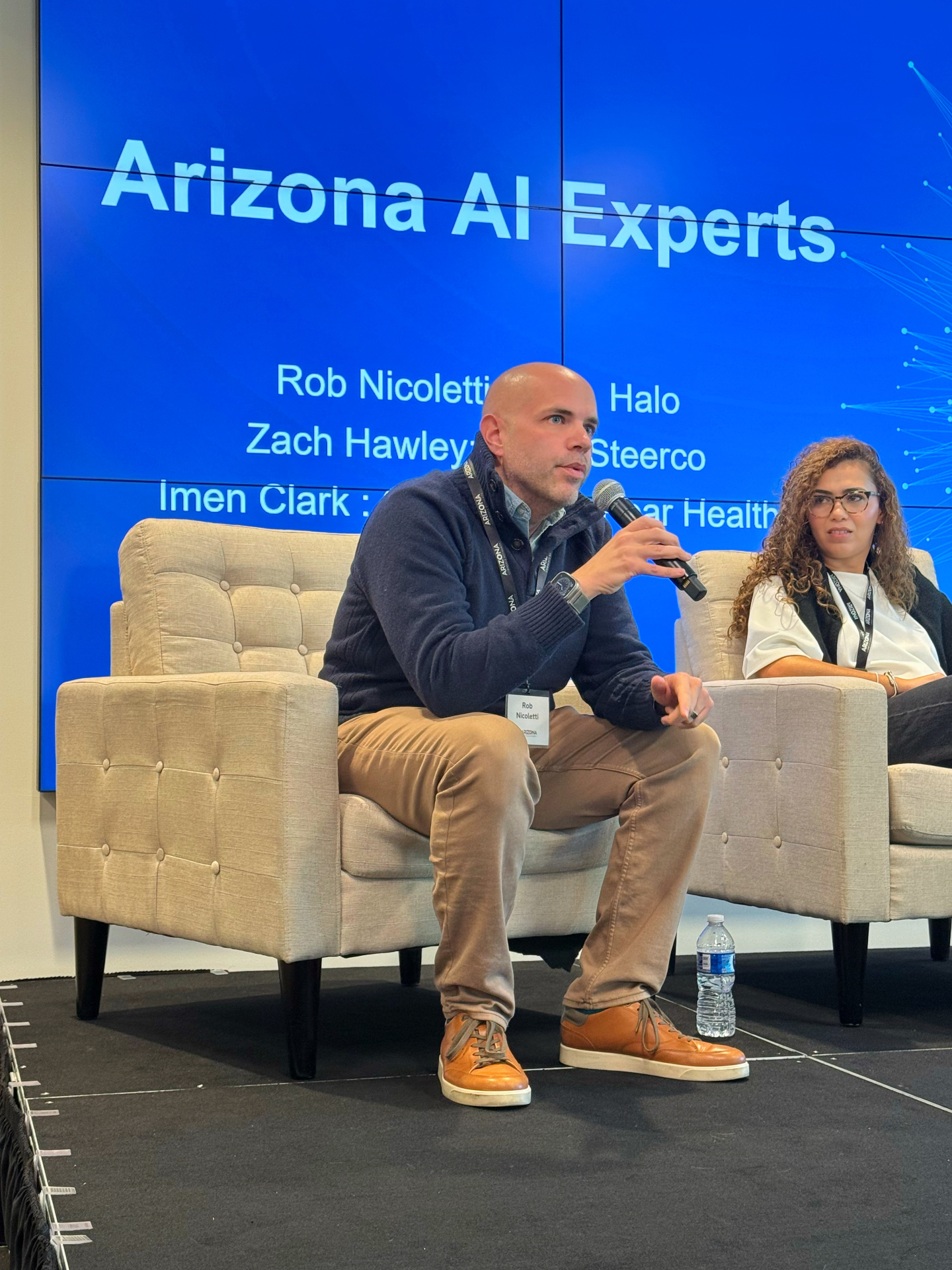
Rob Nicoletti
Founder, create human
Rob is the founder of create human and the architect behind HALO. He has spent the last two decades inside operating teams — building, scaling, and occasionally rescuing them — and writes here about AI, leadership, and what it takes to build organizations where humans become greater, not smaller.
Newsletter
Get the next essay in your inbox.
One email when the next piece of writing lands. No marketing, no list-sharing.