Essay · August 2026
AI Is Here. But Executive Intelligence Is What Will Change Business.
Artificial Intelligence will change how we work. Executive Intelligence will change how we run businesses.
I've asked hundreds of executives a simple question:
"What system do you use to make decisions?"
Most of them are dumbfounded.
They don't have an answer because, in most cases, they don't have a system.
Eventually, I start hearing things like: "I trust my gut." "We have meetings." "I call an advisor." "Experience." "I ask my wife." "I make my best guess." One executive actually told me: "Dumb luck."
And then I point something out that seems completely obvious once you see it.
Look at everyone else in the organization.
- Sales has a CRM.
- Finance has an ERP and financial software.
- Marketing has an entire technology stack.
- HR has an HRIS.
- Customer service has support platforms.
- Operations has project management, workflow and operational systems.
We have spent decades building sophisticated systems to help virtually every function in a company operate. Except the executives. The group with the least amount of time, the broadest responsibility and arguably the highest-consequence decisions has…what exactly?
- Email.
- Meetings.
- Spreadsheets.
- Dashboards.
- PowerPoints.
- Reports.
- Advisors.
- Gut instinct.
- And a calendar that is probably already full.
Make that make sense.
We're asking executives to operate companies in a world of AI using a management model that hasn't fundamentally caught up with the technology surrounding it.
It's Flintstones thinking in a Jetsons world.
We've Digitized the Company, But Not the Executive
This is the paradox. An executive can pull out their phone and ask AI an incredibly complicated question and receive an answer in seconds. Yet ask that same executive: Why did profitability decline across these seven locations last quarter, what is causing it, which locations require intervention, and what should we do about it?
Now watch what happens. Someone needs to pull the numbers. Someone else needs to check the CRM. Finance needs to validate something. Operations needs to provide context. A spreadsheet gets created. A deck gets updated. Emails go back and forth. Then we schedule a meeting. Maybe another meeting. Eventually, leadership gets enough information to make a decision.
We call this running a business. I think future generations will think it's insane.
AI Isn't the Same as Executive Intelligence
This is why I think the conversation about Artificial Intelligence is missing something much bigger. AI is going to transform how work gets done. But there's another category of intelligence we need to create: Executive Intelligence. Or EI.
AI gives machines the ability to perform intelligent tasks. EI gives executives the intelligence required to understand their business and make better decisions about its future. And here's the important part: True EI doesn't exist today.
We have pieces of it. Dashboards tell executives what happened. BI platforms visualize data. CRMs understand customers and pipelines. ERPs manage operational and financial information. AI copilots answer questions. Consultants provide expertise. But executives are still responsible for assembling all of those fragments into a coherent understanding of the business. There is no operating system for the executive.
And Yet Decision-Making Is the Job
This is what makes the problem so strange. One of the most important responsibilities of an executive is making decisions. Where are we going? Where should we invest? What should we stop doing? Where are we underperforming? Why? Who needs help? What risks are emerging? What opportunities are we missing? What happens if we don't act? What should we do next?
These decisions determine the future of the company. They determine whether people get hired. Whether locations open or close. Whether investments get made. Whether customers stay. Whether employees have opportunities. Whether the company grows.
And yet the infrastructure supporting those decisions can be astonishingly primitive.
Imagine telling a salesperson: "Don't worry about the CRM. Just remember everything." We'd never do it. Imagine telling the CFO: "Forget the accounting system. Just use your gut." Absurd. Imagine telling operations: "You don't need a system. Just have more meetings." Ridiculous. But that's essentially what we've done to executives.
Employees Would Be Shocked
I think many employees assume something exists behind the curtain. Some sophisticated executive command center where leadership can see the entire company, understand what's happening and make informed decisions. Usually, there isn't.
There are people working incredibly hard to create that picture manually. Reports. Meetings. Spreadsheets. Presentations. Emails. Dashboards. And a tremendous amount of human interpretation.
If employees understood how some of the biggest decisions affecting their careers and futures were actually being made, I think many would shake their heads. Not because their executives are incompetent. Because we've given executives an impossible operating model. We gave every department systems. Then gave the people responsible for connecting all those departments together almost nothing.
That's the Opportunity for Executive Intelligence
Imagine a different model. An executive starts their day and doesn't need to go looking for information. Their Executive Intelligence system already understands:
- Where the company is going.
- What leadership has committed to accomplishing.
- How every location is performing.
- Which metrics matter.
- Who owns them.
- What has changed.
- Where performance is deviating from plan.
- What is happening with customers and employees.
- What is happening outside the organization.
- And how those things relate to one another.
Then, instead of presenting another dashboard, the system says:
- Here's what changed.
- Here's why it matters.
- Here's what requires your attention.
- Here's what you're not seeing.
- Here's what could happen next.
- Here are your options.
- Now you decide.
That's fundamentally different from AI. And it's fundamentally different from business intelligence. That's Executive Intelligence.
The Human Still Makes the Decision
EI isn't about turning the company over to AI. I don't want AI making every executive decision. I want AI helping humans make extraordinarily good ones.
The executive brings judgment. Experience. Empathy. Values. Context. Leadership. Vision. AI brings computational power, pattern recognition, speed and the ability to process quantities of information humans simply can't.
Executive Intelligence brings those two together inside an operating system designed around how the business actually works. Human judgment + machine intelligence + business context. That's where this gets interesting.
But There Is a Prerequisite
You can't simply connect AI to a bunch of fragmented systems and call it Executive Intelligence. AI needs context. It needs to understand the business. Where are you going? How do you operate? What matters? What are you measuring? Who owns what? How do different parts of the organization relate? What does good performance look like? And where does the underlying data come from?
Alignment comes before automation. Context comes before intelligence.
Before companies can have functional Executive Intelligence, they need an operating system that makes the organization understandable to AI. That's the foundation we're working on at HALO.
From Artificial Intelligence to Executive Intelligence
AI may become one of the most important technological developments of our lifetime. But simply giving everyone AI isn't the destination. The bigger opportunity is changing how organizations themselves operate.
For decades, we've built systems that help employees perform their jobs. Now we have the technology to build something we've never really had: A system that helps executives perform theirs. A system built around the most important thing executives do: Make decisions about the future. Faster. With better information. With greater context. And with intelligence that continuously improves.
The companies of the future won't be run through more spreadsheets, more dashboards, more reports and more meetings. They'll be run through intelligence.
Artificial Intelligence will change how we work. Executive Intelligence will change how we run businesses.
Because running a Jetsons company with Flintstones management systems no longer makes sense.
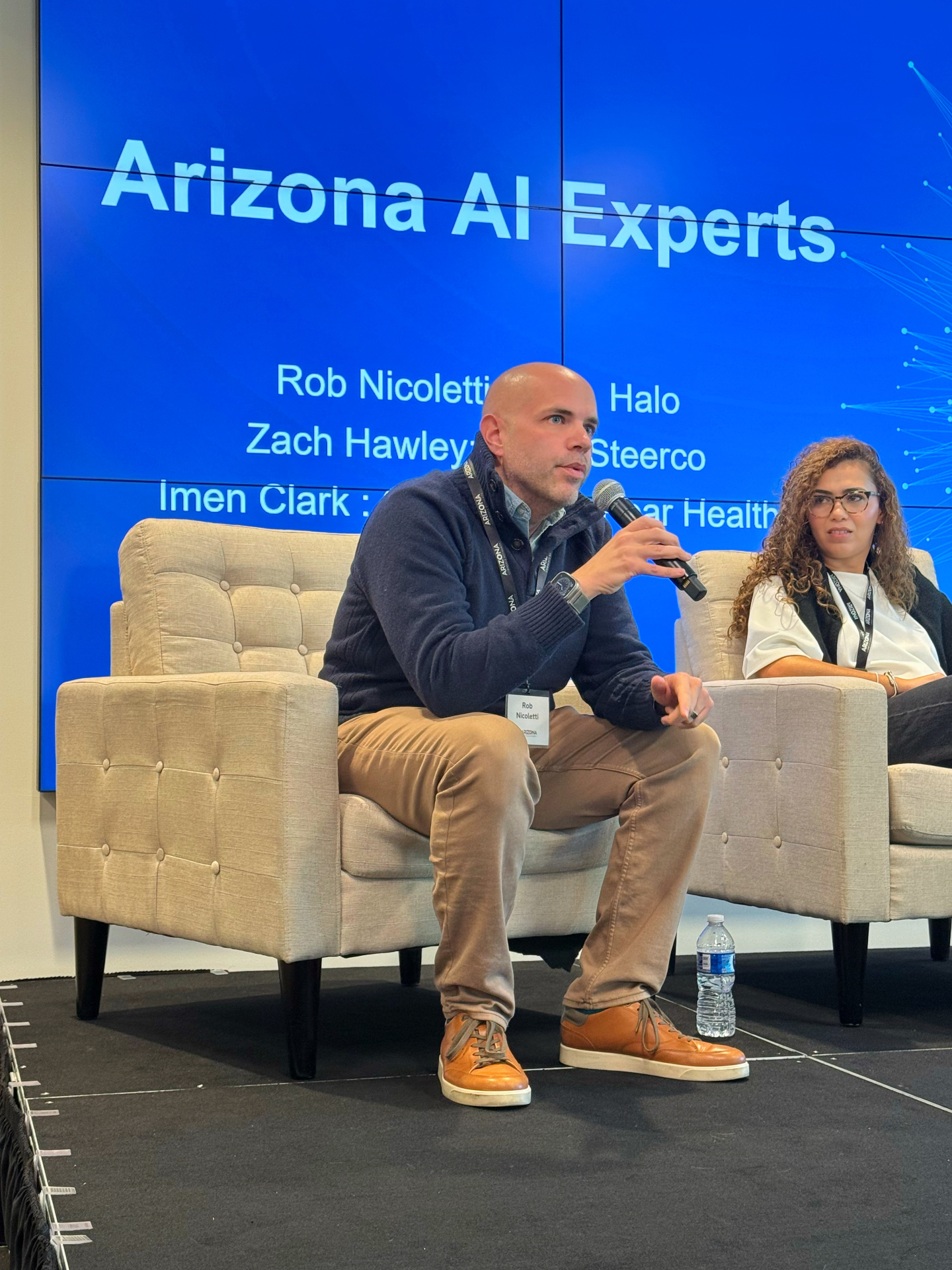
About the author
Rob Nicoletti
Founder, create human
Rob is the founder of create human and the architect behind HALO. He has spent the last two decades inside operating teams — building, scaling, and occasionally rescuing them — and writes here about AI, leadership, and what it takes to build organizations where humans become greater, not smaller.
Newsletter
Get the next essay in your inbox.
One email when the next piece of writing lands. No marketing, no list-sharing.