Essay · June 2026
Why Automotive Service Brands Need an AI Operating System
81% of dealers plan to grow AI budgets in 2025. Every dealership using AI reports revenue gains. The winners treat AI as core infrastructure, not a gadget.
From Fast Lube to Data-Driven Machine
Automotive service chains like Discount Tire, Jiffy Lube and Valvoline are no longer just about oil changes and tire rotations. They manage thousands of SKUs, handle millions of service appointments and orchestrate supply chains that span continents. Yet most operate with manual systems, disjointed data and human-driven processes that can't keep up with rising customer expectations.
The automotive retail and service sector is now embracing artificial intelligence not as a gimmick but as core infrastructure. A recent survey of 200 dealership decision-makers found 81% expect to increase their AI budgets in 2025, with 52% planning increases of 11% or more and 18% anticipating hikes above 25%. Another 95% of dealers see AI as critical to their future success, and more than 80% are already using, implementing or planning to implement AI technology. Early adopters are reaping the rewards: every dealership currently using AI reported revenue gains, with 37% seeing 20–30% growth and 18% achieving more than 30% growth. These numbers underscore why 2026 has been dubbed the industry's 'first true AI operations year.'
Evidence That AI Delivers on the P&L
AI delivers tangible value across the service life cycle — sales, scheduling, inventory management and marketing.
Capturing Every Appointment. Car owners often call for service when the facility is closed or busy, resulting in lost revenue. Impel's Service AI platform solves this by handling inbound calls and text messages around the clock. In a study of 230 dealerships, adopting Impel's AI increased appointment set rates by 27% and lead-to-sale conversion by 26%, while customers became more loyal: vehicle repurchase rates rose 24% and customer win-back rates climbed 33%. Service departments saw 95 additional repair orders per month, a 27% lift in repair order (RO) volume and a 22% jump in service revenue. AI also reduces call centre overhead; one survey showed AI voice agents were the top investment priority for 74% of dealers, while deployments of merchandising automation, pricing analytics and after-sales AI each exceeded 54%.
Managing Supply and Demand. Discount Tire, with over 1,200 stores and more than one million individual item locations, needed to unify disparate systems as it expanded through acquisitions. By implementing Blue Yonder's AI-driven demand planning and replenishment solutions, the retailer aligned stock levels with real-time demand, reduced out-of-stock occurrences and improved profitability. The system delivers highly accurate, probabilistic forecasts that incorporate hundreds of variables and automates routine tasks across departments. The results are dramatic: 90-day purchase forecast accuracy improved by 600 basis points, vendor fill-to-order rates jumped 1,000 basis points, and the company established a centre of excellence to upskill employees and drive continuous innovation. For brands like Jiffy Lube, similar AI-powered replenishment can ensure the right oil grades, filters and parts are always on hand, eliminating stock-outs and reducing costly emergency shipments.
Marketing That Converts. In digital marketing, AI is enabling video creation at scale. When Ken Garff Automotive Group tested Phyron's AI-generated inventory videos across eight dealerships, click-through rates increased by 32.2% and cost per lead dropped 4.7% on average, with some stores seeing reductions of up to 22.9%. These tools eliminated hundreds of hours of manual video production and allowed marketing teams to respond to changing inventory in real time. Dealers also cite AI as one of the top factors improving operational efficiency (57%) and lowering costs (54%).
Operations That Scale. AI doesn't just handle leads and marketing. It optimizes workforce schedules, predicts maintenance needs and automates parts ordering. In service operations, AI-driven communications allow BDC (Business Development Center) agents and advisors to focus on complex customer interactions while automating rote outreach. Impel reports that AI saves dealers 12–15 hours per week in operational work and reduces BDC operating costs by 33%, while boosting showroom appointments by 25–30% and online listing engagement by 67%. AI video and chat agents ensure every customer question is answered, and predictive maintenance algorithms forecast when vehicles will need service, helping brands like Discount Tire or Jiffy Lube schedule appointments proactively.
Addressing Skepticism and Risk
Despite these results, many executives remain wary. In the same Fullpath survey, 72% strongly agreed that AI enhances jobs rather than replacing them. Yet questions linger: Will AI undermine the customer experience? Will it create new compliance or data-privacy risks? And how will it impact frontline roles?
The answer lies in designing AI systems that assist, not supplant. In practice: Assist — use AI to handle routine tasks like answering calls, sending appointment reminders, and processing simple tire quotes so employees can focus on high-value interactions. Automate — once proven, automate workflows like demand forecasting, parts ordering and capacity planning, freeing managers from spreadsheets and manual reconciliations. Augment — finally, leverage AI to augment human judgment. HALO and similar AI operating systems synthesize data from CRM, POS, inventory and repair history to surface the next best action for each customer, whether that's an upsell, a maintenance reminder or a promotional offer.
This progression mirrors the 3As of AI (Assist → Automate → Augment) and anchors AI adoption in a human-centric approach.
Building the Operating System for Automotive Service
Create Human's Five Loops — planning, execution, measurement, learning and adaptation — provide the operating cadence for high-performing service brands.
Plan: Start with clear objectives — reduce missed calls by 50%, improve repurchase rates by 20%, cut inventory holding costs by 10%. Define the KPIs that matter (RO volume, parts fill rate, cost per repair, customer lifetime value) and align the team around them.
Execute: Deploy AI assistants (voice agents, chatbots, predictive scheduling) to assist staff and automate baseline workflows. Integrate AI demand planning into supply chain systems so parts replenishment is automated and accurate.
Measure: Track metrics daily. Are call abandonment and BDC costs declining? Are inventory turns improving? Are repair orders and repurchase rates rising? AI systems should make it easy to measure these outcomes in real time.
Learn: Conduct retrospectives. Did the voice agent misunderstand certain accents? Did the demand forecast adjust too slowly when weather affected oil-change demand? Feed learnings back into models and refine processes.
Adapt: Scale what works. Expand AI scheduling to additional shops, adjust service-interval messaging, or invest in augmented decision dashboards that help managers see cross-store patterns.
The Road Ahead
The automotive service sector stands at a crossroads. Legacy processes, labour shortages and supply-chain complexities threaten margins — but AI offers a way forward. When used intentionally, AI can ensure that every call is answered, every part is stocked, every appointment is optimized and every customer has a personalized experience. The brands that treat AI as a core operating system rather than a point solution will not only protect their margins but also build durable customer relationships. Discount Tire and Jiffy Lube have shown what's possible by leveraging AI for demand planning, replenishment, lead response and service scheduling. The next wave of success will belong to those who combine these tools with a culture of continuous learning and human-centric leadership.
About the author
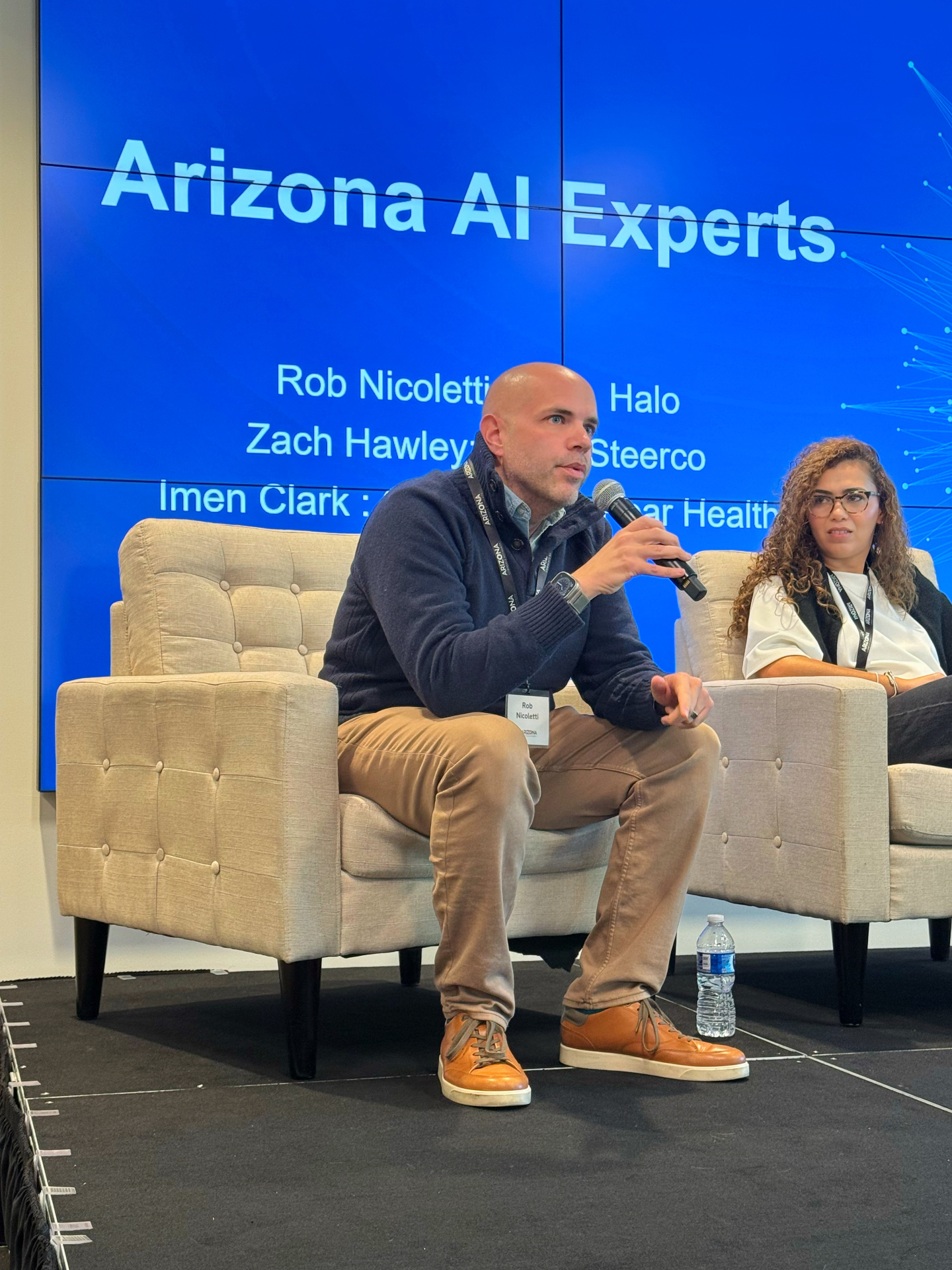
Rob Nicoletti
Founder, create human
Rob is the founder of create human and the architect behind HALO. He has spent the last two decades inside operating teams — building, scaling, and occasionally rescuing them — and writes here about AI, leadership, and what it takes to build organizations where humans become greater, not smaller.
Newsletter
Get the next essay in your inbox.
One email when the next piece of writing lands. No marketing, no list-sharing.