Essay · June 2026
Higher Education's AI Awakening: Turning Adoption into Alignment
66% of institutions have deployed AI, 92% of students use it — yet only 43% have an AI strategy. The sector is adopting fast and aligning slowly.
Artificial intelligence has raced onto campus. A 2025 survey of colleges and universities found that 66% of institutions had deployed AI somewhere in their operations, up from just 49% in 2024. Personal use of AI by administrators remains high — 91% say they use AI tools — yet strategic integration is still uneven. Only 43% of institutions include AI in their strategic plan, though that figure has risen and the proportion of leaders who cite 'lack of a plan' as a barrier has dropped from 13% to 5%. Meanwhile students are flocking to AI faster than their institutions can keep up: surveys suggest 86–92% of students use AI tools, with about 54% using them weekly and roughly a quarter using them daily.
This mismatch creates an uneasy moment. The sector is both adopting AI rapidly and worried about what it means. Data security and privacy remain the top concerns for 56% of institutions and 61% of individual respondents. Environmental impact and job displacement have emerged as new fears, cited by one in five leaders and a growing share of faculty. Below the surface, there's a deeper problem: despite high usage, most institutions lack a unified operating model for AI.
The Adoption Gap
The numbers are stark when you contrast usage and readiness.
Student adoption — A meta-analysis of student surveys found that 86% of students globally use AI, with 54% using it weekly and ~25% using it daily. In the UK, the proportion of students using generative AI for assessments surged from 53% to 88% in a single year. By 2025, 92% of UK students were using some form of AI tool, yet only 29% felt their institution encouraged them to do so.
Faculty adoption — Faculty are catching up but still lagging: a summary of surveys found 61% of faculty have used AI, yet 88% use it minimally and only 17% feel they have advanced or expert skill. A separate study found 93% of higher-education staff plan to expand AI use, indicating enthusiasm without readiness.
Preparation and training — Despite the high stakes, 58% of students and 59% of leaders believe students are not adequately prepared for AI-driven workplaces. Only 36% of students in a UK survey reported receiving AI training, and fewer than half believed their staff were well equipped to guide them.
Departmental divides — Adoption is uneven across campus. IT (81%), data and analytics (75%) and executive leadership (73%) are the leading adopters, whereas financial aid (43%) and admissions (47%) remain cautious.
High usage in pockets and low strategic integration elsewhere creates risk. Without consistent policies and governance, AI can propagate bias, undermine trust and reinforce existing inequities. Many faculty members remain uncomfortable with generative tools because of concerns about cheating, plagiarism and accuracy; more than half of students worry about false results and being wrongly accused of cheating. First-generation students and underrepresented groups often feel less confident in using AI ethically and effectively.
Why the Gap Exists
Lack of policy and governance. Only 43% of institutions have formal AI strategies. Without guidance, departments adopt tools piecemeal. This fosters shadow use and inconsistent experiences for students and staff.
Data concerns. Leaders cite data privacy and security as the top barrier. The higher-education sector holds sensitive student records, so any AI adoption must meet stringent legal and ethical standards.
Training and literacy gaps. Most faculty and students have not received formal AI training. Without skills and understanding, they are reluctant to integrate AI into pedagogy or administrative processes.
Ethical uncertainty. Students and educators fear misuse — from bias in admissions algorithms to plagiarism and hallucinated citations. Trust remains a fragile asset.
Adoption without architecture is a recipe for disappointment. AI success requires an operating system that aligns people, processes and technology.
A Framework for Responsible AI in Higher Education
At Create Human, we argue that AI success is not just about buying new tools; it requires an operating system that aligns people, processes and technology. Our frameworks offer a path forward.
Assist → Automate → Augment. Start by using AI to reduce administrative burdens and free up time for human connection. Tools that provide automatic transcriptions, summarize readings, or offer grammar and research support help students and faculty focus on critical thinking and mentorship. AI chatbots can answer routine questions about enrollment and financial aid so staff can devote more time to nuanced advising. Once processes are documented and consistent, AI can automate repeatable tasks — scheduling, billing, compliance checks and early alerts for at-risk students. AI-driven early-warning systems can flag students who miss coursework or show declining engagement, prompting advisers to intervene. The greatest potential lies in augmentation: using AI to enhance human decision-making. Predictive analytics can model cohort risk factors and inform resource allocation; generative tools can help faculty design individualized learning pathways.
The Five Loops. Create Human's operating cadence — planning, execution, measurement, learning and adaptation — provides a blueprint for AI readiness. Plan: Define clear objectives for AI; align them with institutional mission and student outcomes; address data privacy and equity from the start. Execute: Roll out pilots with cross-functional teams that include faculty, IT, students and ethics experts. Measure: Monitor the impact on learning outcomes, operational efficiency and equity. Learn: Use data to identify gaps, biases or unintended consequences. Adapt: Institutionalize what works by updating policies, training programs and resource allocation. Treat the AI strategy as a living document.
Moving Beyond Pilots
Higher education stands at a crossroads. Students and staff are racing ahead, but institutional policies and culture lag behind. The solution is not to slow down, nor to relinquish caution. Instead, leaders must pair rapid adoption with rigorous alignment. AI should assist, then automate, and finally augment the work of educators and administrators. Institutions must invest in governance, training and feedback loops to ensure AI supports human potential rather than undermining it.
Done well, AI can relieve overworked faculty, personalize support for diverse learners, and free administrators to focus on strategic decisions. Done haphazardly, it will entrench biases, erode trust and leave the sector chasing the next tool without realizing meaningful change. The choice is ours. Create Human's frameworks and HALO's AI-ready operating system provide a path toward a more aligned, human-centric future for higher education.
About the author
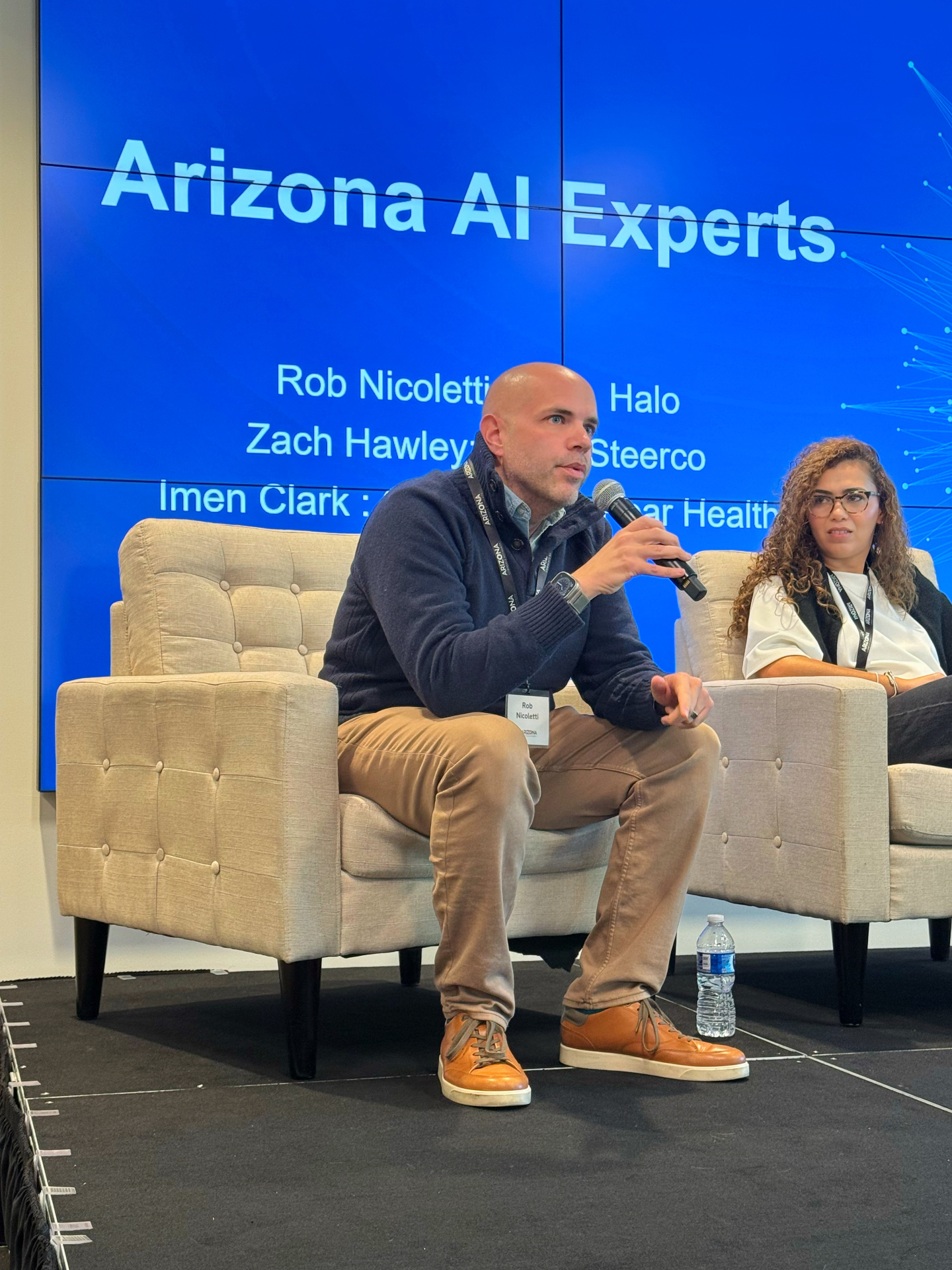
Rob Nicoletti
Founder, create human
Rob is the founder of create human and the architect behind HALO. He has spent the last two decades inside operating teams — building, scaling, and occasionally rescuing them — and writes here about AI, leadership, and what it takes to build organizations where humans become greater, not smaller.
Newsletter
Get the next essay in your inbox.
One email when the next piece of writing lands. No marketing, no list-sharing.