Essay · June 2026
Put Your Oxygen Mask on First: Why Executives Must Free Themselves Before Automating the Organization
Executives adopt AI while remaining trapped in low-value work. The leverage exists, but leaders aren't seizing it.
Every flight attendant says it: "Put on your own oxygen mask before assisting others." For executives navigating the AI era, it's not just a safety protocol — it's a strategy. Too many leaders attempt to implement automation across their organizations while they remain suffocated by reactive work. The result is chaos layered on top of chaos: more tools, more dashboards, but no time to think.
The Overload at the Top
Research into executive productivity paints a worrying picture. In the 2025 Prialto Executive Productivity Report, 78% of executives reported using AI tools, a dramatic rise from 51% in 2023. Yet only 26% of those leaders fully trust the output. Meanwhile, a survey of 5,000 leaders by productivity expert Barry O'Reilly found that 72% listed "not knowing where to start" as their biggest blocker, 61% lacked a clear AI strategy, and 46% feared wasting time on tools without a clear ROI. Despite this uncertainty, 92% believed AI could significantly boost personal productivity.
Time allocation remains the core problem. McKinsey's research on executive time management shows that leaders spend 20–30% of their time on administrative tasks and less than 10% on long-term strategy. Only 52% say their time aligns with strategic priorities, and just 9% of executives are "very satisfied" with how they allocate their hours. Even though AI users save an average of 7.5 hours per week — the equivalent of a full workday — executives themselves report using AI only about 1.5 hours per week. The leverage exists, but leaders aren't seizing it.
Why You Must Free Yourself First
The data highlight a paradox: executives adopt AI while remaining trapped in low-value work. They automate from the bottom up before redesigning their own workflows. This is like trying to run while still strapped to your seat.
Focusing on your own oxygen mask means:
- Reclaim time for judgment. AI summarization tools, meeting co-pilots and automated scheduling can recover hours every week. For example, Microsoft's 365 Copilot users saved about 2.25 hours per week on email drafting, meeting summaries and report generation. An LSE/Protiviti study found AI users save 7.5 hours per week, worth roughly £14,000 per employee annually. If leaders use these tools intentionally, they can shift their calendars from reactive tasks to proactive thinking.
- Design before you automate. As Barry O'Reilly notes, the fastest way to waste time with AI is to "automate chaos." He advises leaders to identify repetitive, manual tasks first and design a workflow before selecting tools. This principle applies across the organization: clarity of outcomes and decision rights must precede automation.
- Shift from doing to deciding. Executive work is unique: it requires synthesis, judgment and communication. AI should act as a junior analyst — producing first drafts, categorizing information and surfacing insights — while you retain the final call. Treat AI as an amplifier of your judgment, not a replacement.
Putting on your oxygen mask first is not selfish; it's essential.
Creating an AI‑Ready Operating Model
Create Human's frameworks offer a roadmap for leaders who want to breathe deeply before turning to automation. Two concepts are paramount:
Assist → Automate → Augment
Assist — Use AI to handle repetitive executive tasks: summarizing meetings, drafting communications, managing your calendar. These "oxygen mask" activities free you to think about strategy and culture.
Automate — Once your leadership workflows are stable, apply automation across teams. Automate report generation, compliance checks, and standard onboarding processes. But only after you have defined the outcomes you want.
Augment — Finally, use AI to enhance judgment. Predictive analytics can forecast market trends or employee churn; generative tools can help craft strategic narratives. Augmentation is where AI becomes a thought partner, but it requires trust and transparency.
The Five Loops
Create Human's operating cadence — Planning, Execution, Measurement, Learning and Adaptation — ensures AI adoption is continuous, not chaotic:
- Planning: Define your executive priorities. Decide what success looks like, and identify the tasks that currently consume your time but don't contribute to strategy.
- Execution: Pilot AI tools on your own workload first. Document how you use AI and the returns you see. If AI can save you 7.5 hours per week, reinvest that time into coaching your leaders and aligning the organization.
- Measurement: Track the impact of AI on your calendar and your team's outcomes. Are you spending more time on strategy? Are decisions faster? Are employees more engaged?
- Learning: Share your experience with your team. What worked? What didn't? Which tasks were easy to automate and which still require human nuance?
- Adaptation: Use insights from your own experience to scale AI adoption. Develop policies, train managers, and embed AI across workflows — but only after your own oxygen mask is secure.
The Bottom Line
You cannot lead an AI transformation while drowning in administrative work. The statistics make it clear: leaders are still consumed by tasks that machines can handle, even though they believe AI could significantly boost productivity. Putting on your oxygen mask first is not selfish; it's essential. When you free your time, define your strategy and trust your tools, you create the clarity and capacity needed to lead automation across your organization. Your team sees you model the behavior they must adopt. AI amplifies your judgment rather than replacing it, and the entire organization benefits.
About the author
Rob Nicoletti
Founder, create human
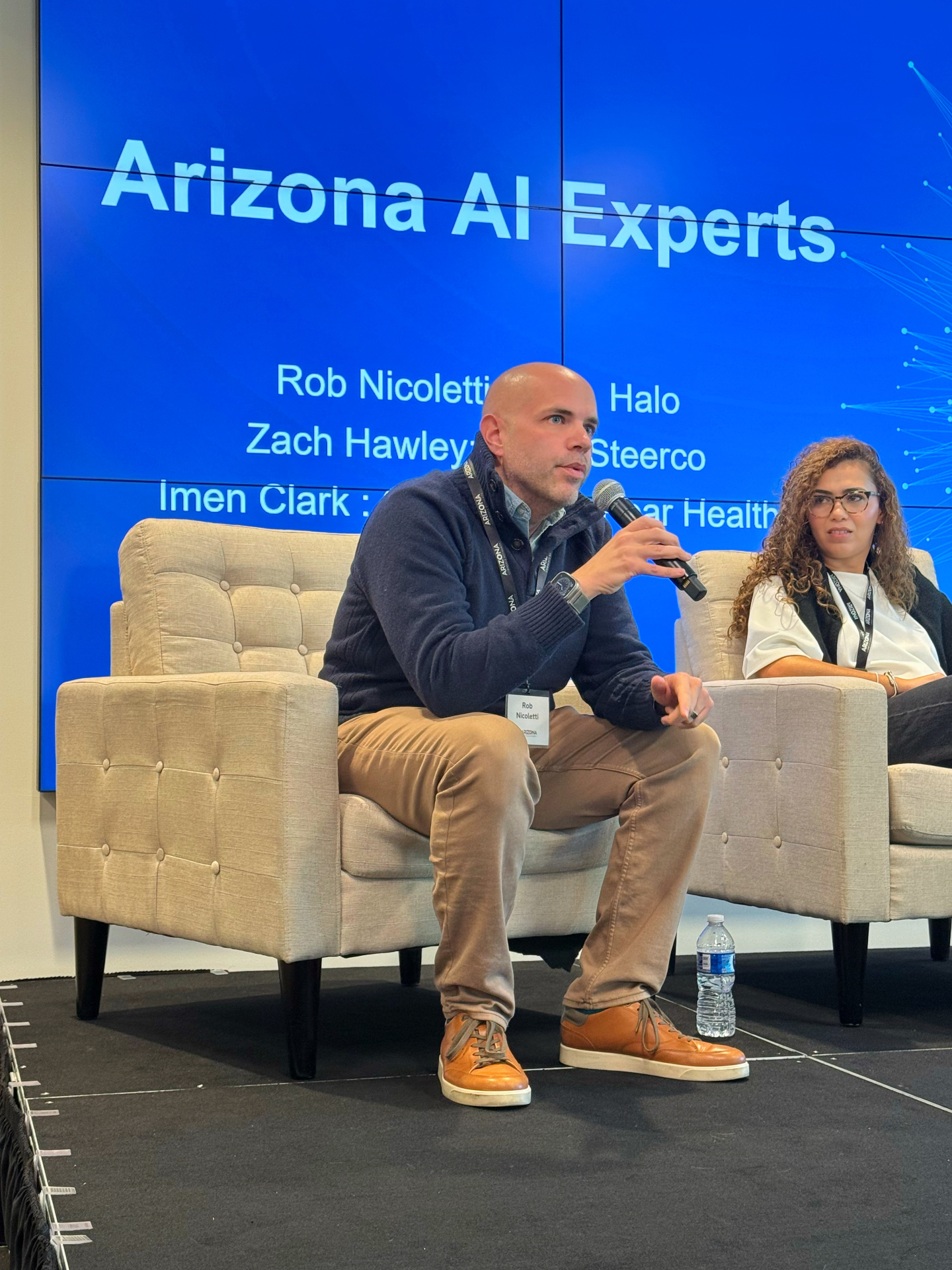
Rob is the founder of create human and the architect behind HALO. He has spent the last two decades inside operating teams — building, scaling, and occasionally rescuing them — and writes here about AI, leadership, and what it takes to build organizations where humans become greater, not smaller.
Newsletter
Get the next essay in your inbox.
One email when the next piece of writing lands. No marketing, no list-sharing.