Essay · June 2026
Healthcare's AI Paradox: Widespread Adoption, Shallow Integration, and the Path Forward
Everyone is adopting AI in healthcare. Few are reaping transformational value. The difference is leadership.
Adoption Everywhere, Impact Nowhere?
Health care has rushed to embrace artificial intelligence. By 2025, around 80% of U.S. hospitals were using AI in at least one clinical or operational function, and 89% of healthcare executives reported deploying AI somewhere in their organizations. The U.S. Food and Drug Administration had cleared or approved approximately 1,250 AI- or machine-learning-enabled medical devices as of May 2025, and the global AI-in-healthcare market is forecast to exceed $100 billion near 2030. More than two-thirds of U.S. physicians used AI in 2024, a jump of 78% from the year before.
Yet adoption breadth hides a nagging truth: deep integration is rare. Fewer than one in five institutions report sustained, 'high-success' use of AI in core clinical diagnosis. Health systems operate an average of five or more AI vendors, but those tools often sit on the periphery, providing ambient note-taking or predictive risk scores without transforming core workflows.
A recent survey of U.S. health systems found that reducing caregiver burden and improving staff satisfaction was the top priority for deploying AI (72% of organizations ranked it among their two highest goals), followed by patient safety/quality (58%) and workflow efficiency/productivity (53%). Margin improvement and consumer experience barely registered. Imaging and radiology AI was deployed in at least limited areas by 90% of respondents, early sepsis detection by 67%, ambient note-taking by 60%, and risk-of-deterioration models by 56%. But full deployment lags: only 14% of organizations had fully rolled out ambient notes.
Good News: ROI Is Emerging
Despite shallow integration, AI investments are starting to pay off. In Eliciting Insights' 2026 survey of 120 U.S. health systems, 75% of organizations were using or planning at least one AI application, and there was a 67% year-over-year increase in multi-solution deployments. The most widely adopted use cases included clinical note-taking/ambient listening (68% adoption), AI-based clinical documentation improvement (43%), AI coding (36%), and draft replies to patient messages (36%).
More than half of health systems able to quantify results reported at least a 2x return on investment. AI-based CDI and denial prediction led the pack, with around 70% of users achieving 2x+ ROI, followed by AI coding (66%) and ambient listening (61%). These solutions reduce manual work, accelerate revenue capture and relieve clinician burnout.
At the insurer level the trend is similar. The U.S. health plan market faces $98 billion in prior-authorization and administrative costs, yet only about 3% is currently addressed by software. Physicians spend 13 hours per week on prior authorization and 89% say it contributes to burnout. AI-powered automation is growing tenfold year-over-year, from $10 million in 2024 to $100 million in 2025. One collaboration processed more than 200,000 authorizations annually with a 96% first-pass approval rate. The 2026 HealthEdge Annual Payer Report indicates that 94% of payers have now adopted AI, focusing on prior authorization and claims adjudication.
Bad News: Trust and Governance Lag Behind
While clinicians and executives are bullish, patients remain cautious. Surveys reveal that less than one-fifth of hospitals have embedded AI deeply into clinical decision-making, and patient trust is fragile. Many organizations cite data privacy and compliance concerns as the top barriers to adoption, alongside change-management and governance challenges. Without thoughtful oversight, AI can amplify existing inequities or introduce new errors. Prior authorization rules, for instance, are being forced by regulators to shorten decision timelines and share metrics publicly, raising the stakes for accuracy and fairness.
The disconnect between widespread experimentation and deep integration points to a leadership problem. Health systems often launch pilots without clear goals or feedback loops. Governing boards are unsure how to oversee AI risk. Clinicians lack training on how to interpret AI recommendations, and IT departments are stuck managing vendor sprawl. This is where Create Human and HALO come in.
Everyone is adopting AI, yet few are reaping transformational value. The difference lies in whether leaders treat AI as an add-on or as a catalyst for organizational learning.
Applying Create Human's 3As: Assist, Automate, Augment
Assist clinicians first. Early deployments that succeed focus on assisting clinicians with routine tasks. Ambient listening and AI scribes reduce physician documentation time by 40–45%, giving doctors more time with patients. These tools must be transparent: clinicians need to see and edit the AI-generated note. HALO's approach is to present AI suggestions as drafts, not final answers, encouraging humans to apply judgment.
Automate administrative burden. Beyond scribes, AI can automate coding, claims denial prediction and prior authorization. As Eliciting Insights found, AI coding solutions deliver 2x returns for 66% of adopters. Prior-authorization automation reduces manual work and accelerates decisions. But automation must be governed: algorithms should be monitored for bias and aligned with regulatory timelines.
Augment clinical decision-making. The frontier is augmenting diagnosis and care. Predictive models can identify patients at risk of sepsis, falls or readmission. Narrow AI models now reach 96% accuracy in diabetic-retinopathy detection and 90–92% sensitivity in early-stage breast-cancer detection. These tools should not replace clinicians but augment them. HALO's strategy is to embed predictions into workflows with clear explanations and to let providers override recommendations.
Integrating AI with Create Human's Five Loops
- Planning: Define success beyond adoption metrics. Decide whether the primary goal is reducing caregiver burden, improving patient safety, accelerating revenue or all of the above. Create CAMP documents for each role — physicians, nurses, coders — so everyone understands how AI fits into their work. Plan for deep integration and change management, not shallow pilots.
- Execution: Roll out AI in stages. Start with assisting tasks (scribes, coding), then automate administrative workflows (prior authorization, denial prediction), and finally augment care (risk stratification, personalized treatment). Use HALO to coordinate workflows across teams and vendors.
- Measurement: Track not just adoption but outcomes — clinician time saved, reduction in denials, improvement in documentation quality, patient safety incidents, payer turnarounds. Evaluate ROI and soft benefits like burnout reduction and patient satisfaction. When measured, more than half of organizations report 2x+ ROI from AI solutions.
- Learning: Create feedback loops for clinicians, coders and patients. When AI suggestions are wrong or confusing, record why and adjust. When ambient listening notes require heavy editing, refine prompts and models. Use HALO's analytics to see where AI is helping and where it's hindering.
- Adaptation: Iterate on governance. Establish AI oversight committees that include clinicians, ethicists and IT leaders. Set policies for data privacy, model evaluation and vendor selection. Reduce vendor sprawl by consolidating around platforms that integrate multiple functions. Keep pace with regulation — the CMS Interoperability and Prior Authorization Final Rule requires FHIR-based APIs and public reporting of approval metrics.
Healthcare's Future: Human-Centered Intelligence
AI's diffusion across healthcare is inevitable, but its impact is not predetermined. Today's data reveal a paradox: everyone is adopting AI, yet few are reaping transformational value. The difference lies in whether leaders treat AI as an add-on or as a catalyst for organizational learning.
Create Human and HALO advocate for a progression — from assisting to automating to augmenting — and for closing the loop between adoption, measurement, and adaptation. When applied thoughtfully, AI can relieve caregiver burden, improve documentation, accelerate revenue and enhance patient safety. It can help humans become better decision-makers, not obsolete ones. The challenge is to pair technology with clarity, governance and culture — and to remember that in healthcare, trust is both the most fragile and the most valuable asset.
About the author
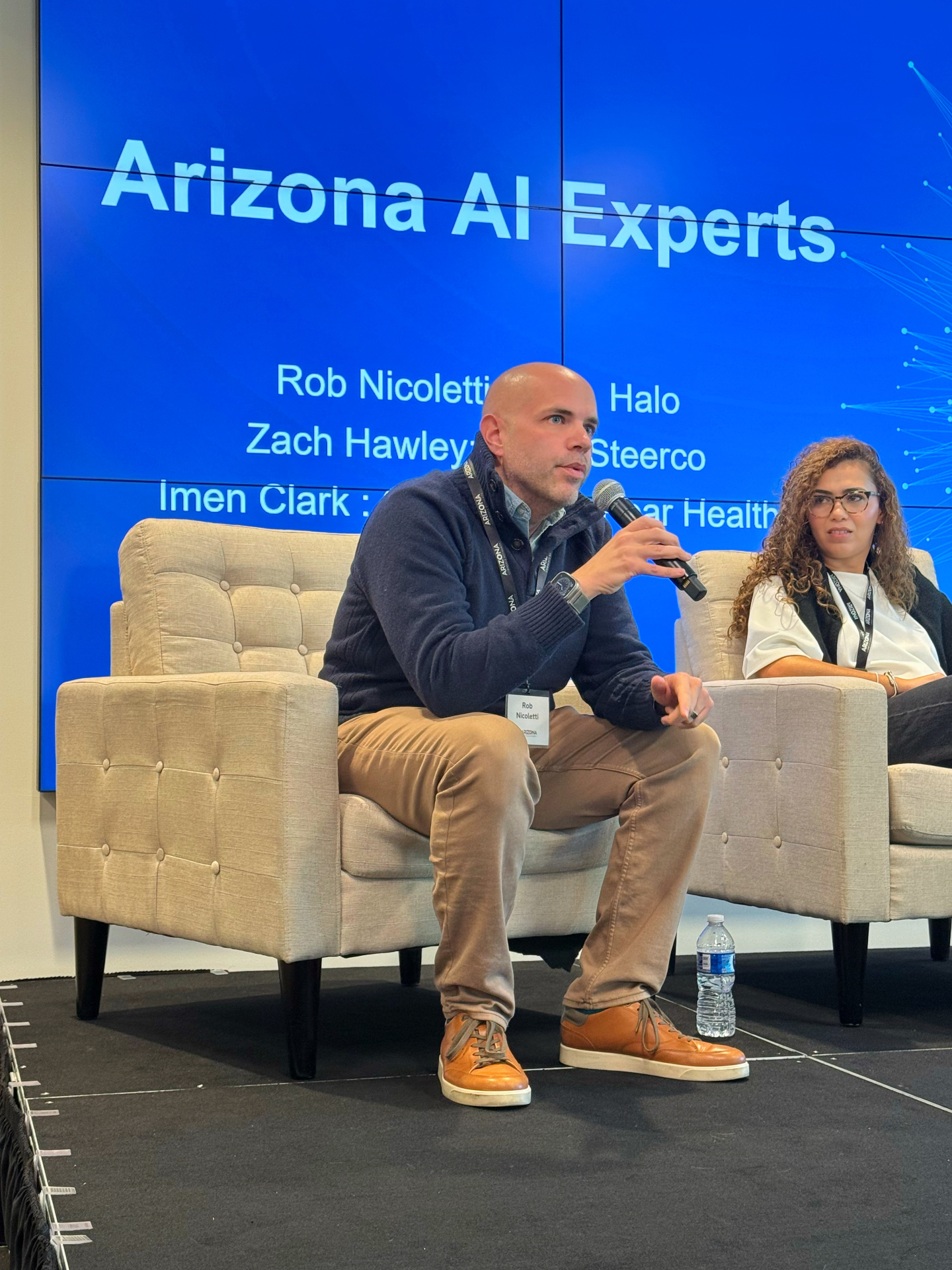
Rob Nicoletti
Founder, create human
Rob is the founder of create human and the architect behind HALO. He has spent the last two decades inside operating teams — building, scaling, and occasionally rescuing them — and writes here about AI, leadership, and what it takes to build organizations where humans become greater, not smaller.
Newsletter
Get the next essay in your inbox.
One email when the next piece of writing lands. No marketing, no list-sharing.