Research note · June 2026
The leadership gap AI was supposed to close
What we've learned working with mid-market operators.
AI was sold to executives as a way to reduce dependence on human leaders. Algorithms would make complex decisions, eliminate bias and drive flawless execution. Yet the reality on the ground tells a different story. In 2025, researchers at MIT analyzed 300 public generative AI deployments and found that 95% of pilots produced no measurable profit-and-loss impact. Only about 5% of pilots achieved rapid revenue acceleration. Tools purchased from specialized vendors reached deployment about 67% of the time, while internal builds succeeded roughly one-third as often. The reason wasn't model quality; it was organizational structure — long approval chains and unclear decision rights. In other words, AI did not close the leadership gap; it exposed it.
The mid-market mirror
The story is the same in the mid-market. RSM's 2025 Middle Market AI Survey, summarized by QueryNow, shows that 91% of mid-market organizations use generative AI, but only 25% have it fully integrated into core operations, and another 43% have partial integration. Sixty-two percent of executives found generative AI harder to implement than expected, 92% encountered implementation challenges, and 70% said they needed external help to capture value. Remarkably, 88% of respondents reported that AI had affected their organization more positively than expected, despite the difficulties. This combination of high adoption and low integration underscores a leadership gap: appetite exceeds execution.
Leaders underestimate their people's readiness and overestimate their own.
Workforce perception
Leadership gaps are visible in workforce perceptions, too. The Adecco study reports that only 22% of leaders are confident their organizations are building future-ready capabilities, 31% believe leadership has sufficient AI skills, and only 36% feel their talent strategy demonstrates that AI creates opportunities for workers. Meanwhile, 70% of workers feel ready to collaborate with AI, far higher than the 39% of leaders who think employees would be comfortable.
What we see in the field
Our own work with mid-market operators confirms these patterns. The difference between pilots that stay on slide decks and systems that reach production is not budget or technology. It is decision rights — how few people can veto the build. It is scope clarity — whether the problem and success criteria are defined before the code is written. It is change management — whether employees are engaged early and trained for new roles. In HALO deployments, the teams that succeed are those where executives own the workflow, align on what success looks like and empower small, cross-functional teams to iterate. They treat AI as a partner in judgment, not a substitute for leadership. Closing the leadership gap requires leaders to rearchitect their operating models, not just buy smarter software.
About the author
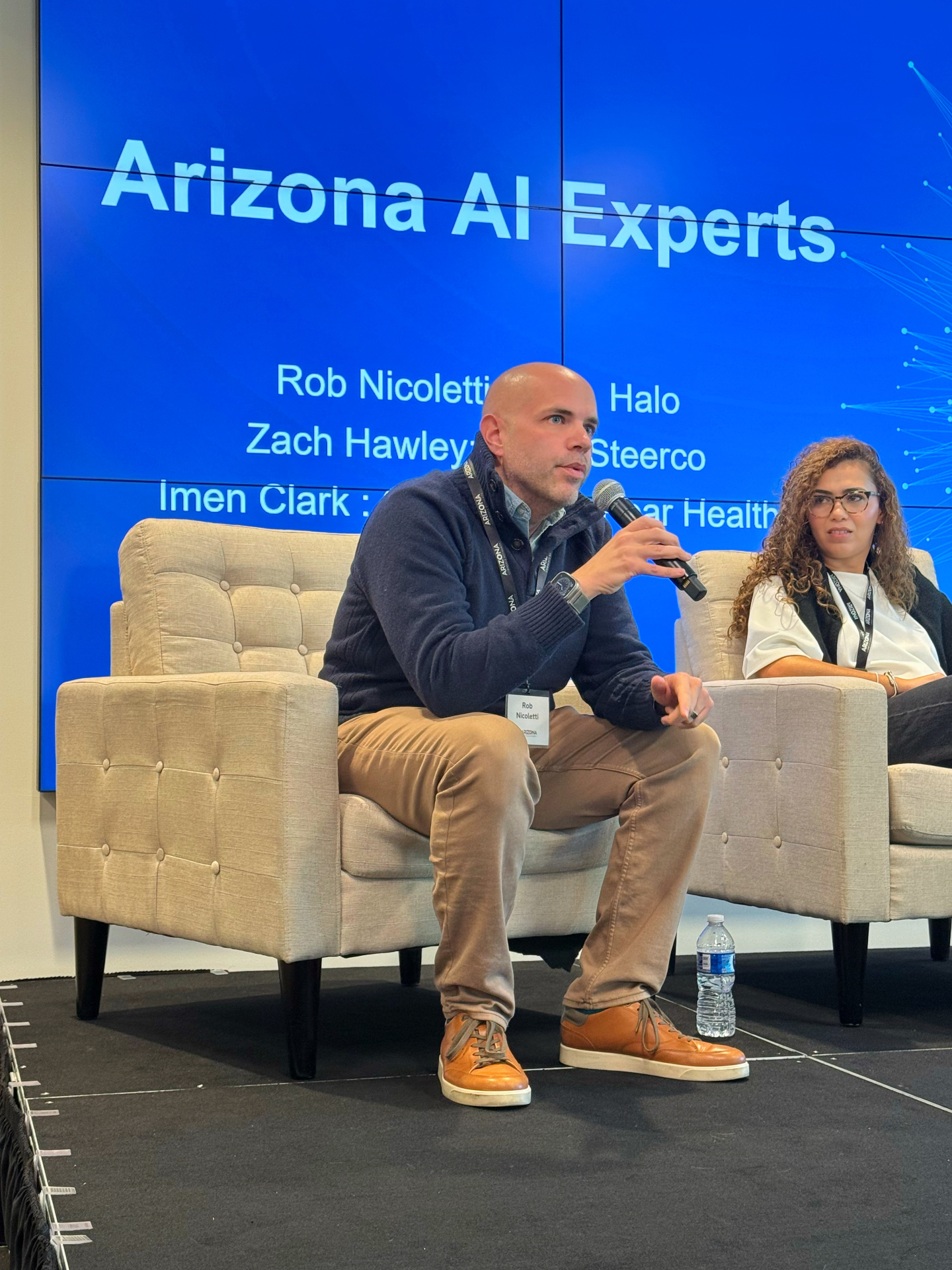
Rob Nicoletti
Founder, create human
Rob is the founder of create human and the architect behind HALO. He has spent the last two decades inside operating teams — building, scaling, and occasionally rescuing them — and writes here about AI, leadership, and what it takes to build organizations where humans become greater, not smaller.
Newsletter
Get the next essay in your inbox.
One email when the next piece of writing lands. No marketing, no list-sharing.